Weather in the Sahara Desert Morocco — When to Go and What to Expect
Monthly temperatures, seasonal conditions, sandstorm risks, packing lists, and the honest answer to when the Moroccan Sahara is at its best for your specific trip.
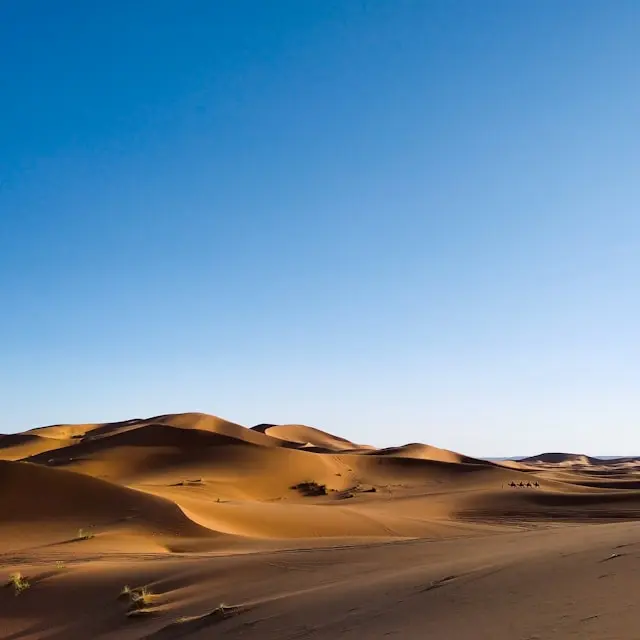
The weather in the Sahara Desert Morocco is one of the most misunderstood aspects of planning a desert trip. Most people expect relentless heat. What they do not expect is a night temperature of 4 degrees Celsius at the same camp that reached 42 degrees at midday. They do not expect the Chergui wind to carry fine sand through every zip and pocket. They do not expect the complete silence and the clearest sky most of them have ever seen.
This guide covers Morocco desert weather month by month, explains the climate forces that shape it, and gives you the practical information you need to choose the right window, pack the right kit, and understand what you are dealing with when you step off the camel at camp.
Understanding the Saharan Climate — More Than Just Heat
The Diurnal Temperature Swing — Why Nights Are Freezing
The defining characteristic of Sahara Desert weather Morocco is not the maximum temperature — it is the gap between the maximum and the minimum on the same day. In October, the dunes around Merzouga reach 28 degrees Celsius at 2pm and drop to 10 degrees at 3am. In January, the midday sun warms the sand surface to 30 degrees while the air temperature falls to 3 degrees by midnight. In July, the gap is less dramatic but still significant: 42 degrees at midday, 22 degrees at 3am.
The reason is simple. Sand and bare rock have very low thermal mass — they absorb heat fast and release it fast. Without cloud cover or vegetation to retain warmth, the ground radiates its heat directly into the sky from sunset onward. The result is temperature swings of 20 to 30 degrees Celsius within a single 24-hour period that are genuinely unusual even compared to other desert environments globally.
The Rain Shadow Effect — How the Atlas Mountains Shape the Desert
The High Atlas Mountains are the primary reason the Moroccan Sahara is as dry as it is. Atlantic weather systems moving in from the west drop most of their moisture on the northern and western slopes of the Atlas. By the time that air mass crosses the mountains and descends into the pre-Saharan south, it has lost most of its water content and is compressed and warmed further by the descent. This is the classic rain shadow effect, and it is responsible for the abrupt landscape change visible on any drive from Marrakech over Tizi n’Tichka pass — green and olive-covered on the northern slope, red and bare on the southern.
Annual rainfall at Merzouga averages 30 to 50 mm — roughly the same as the driest parts of the Atacama Desert. Most of this falls in November and March in brief, intense storms that can run dry riverbeds with surprising force within minutes of the first drop.
 The pre-Saharan south receives almost no rainfall — the High Atlas intercepts Atlantic moisture before it reaches Merzouga.
Humidity and Air Quality in the North African Wilderness
Relative humidity in the Merzouga desert averages 20 to 35 percent — low enough to dry skin, lips, and nasal passages within hours of arrival. Visitors acclimatised to humid European or North American conditions notice the dryness within the first afternoon. Throat irritation and nosebleeds from dry mucous membranes are common on the first night. Drinking 3 to 4 litres of water per day is the standard recommendation, and moisturiser becomes a practical necessity rather than a cosmetic one.
On most days, air quality is exceptional — visibility across the dunes can exceed 50 km in clear conditions. The exception is the Chergui wind period, when windblown dust reduces visibility to a few hundred metres and fine particles penetrate everything.
The Best Time to Visit — A Seasonal Breakdown
The table below gives the average temperature ranges for Merzouga across the year. Use it alongside the seasonal profiles below to match your travel dates to the right conditions.
| Month | Day Temp | Night Temp | Rainfall | Conditions |
|---|---|---|---|---|
| January | 18°C | 3°C | 4 mm | Cold nights, clear, quiet |
| February | 21°C | 5°C | 5 mm | Cool, pleasant days |
| March | 25°C | 9°C | 6 mm | ★ Peak season begins |
| April | 28°C | 13°C | 5 mm | ★ Ideal conditions |
| May | 33°C | 17°C | 3 mm | Warm, last comfortable month |
| June | 38°C | 21°C | 1 mm | Heat building |
| July | 42°C | 23°C | 1 mm | Extreme heat |
| August | 42°C | 22°C | 2 mm | Hottest month |
| September | 36°C | 18°C | 3 mm | Cooling, transition month |
| October | 28°C | 12°C | 4 mm | ★ Best light, ideal temps |
| November | 23°C | 7°C | 7 mm | ★ Quiet, excellent conditions |
| December | 19°C | 4°C | 5 mm | Cold nights, clear skies |
The most popular window for desert tours. Dune colours are at their most saturated in the low March and April sun. The Dades Valley greens briefly. Atlas snow provides a backdrop. Temperatures are comfortable for camel trekking, walking, and long days outdoors. Book accommodation 2 to 3 months ahead as this is the busiest period.
★ Peak season — book earlyOctober and November give conditions nearly identical to spring but with fewer tourists and lower prices. The dune light in October afternoon hours is the best of the year. September is still warm — a transition month better avoided for extended daytime activity. November can bring occasional short rain.
★ Best overall conditionsCold nights require proper warm gear — a sleeping bag liner and a down jacket for the camp nights are not optional in January. Days are mild and sunny, rarely cold. Camps are quiet. The sky is at its clearest. For photographers, the low winter sun on the dunes creates shadows that are impossible to replicate in summer. Almost no other tourists.
★ Quiet — warm gear essentialGenuinely extreme. Surface sand temperature reaches 70 degrees Celsius. Physical activity outdoors between 10am and 5pm is not recommended. All desert tours in summer shift the camel trek to dawn, the 4×4 excursion to early morning, and rely on air conditioning during midday. Lowest prices of the year. Suitable for experienced travellers who understand heat risk.
Heat warning — experienced travellers onlyRegional Micro-Climates — Merzouga vs M’Hamid El Ghizlane
 Erg Chebbi’s 150-metre dunes near Merzouga — the most accessible Sahara in Morocco and the benchmark for desert weather conditions.
Erg Chebbi — Merzouga
Erg Chebbi is the primary desert destination for most Morocco desert tours — 150-metre dunes, 28 km in length, 560 km from Marrakech on paved road. At 1,100 metres altitude, it sits slightly higher than the surrounding Draa plains, which moderates the absolute maximum temperatures very slightly. It also sits at the western edge of a large flat reg (rocky desert plain) that channels easterly winds directly onto the dune face, making it more exposed to Chergui winds than the more sheltered Erg Chigaga.
Erg Chigaga — M’Hamid El Ghizlane
Erg Chigaga, 60 km south of M’Hamid on piste track, is lower altitude and further south — meaning slightly higher summer temperatures and more wind exposure. The wind at Erg Chigaga is stronger and more consistent, which creates more dynamic dune formations but also more dust. Multi-day camel treks crossing Erg Chigaga are best planned for October, November, and March — the same optimal windows as Erg Chebbi, but with a higher margin of wind risk outside these months.
The Atlas Mountains’ Influence on the Journey from Marrakech
The 2,260-metre Tizi n’Tichka pass on the road from Marrakech to Ouarzazate introduces a significant climate shift within a single day’s driving. In winter, the pass can be closed by snow while Merzouga simultaneously has 18 degrees of sunshine. Check road conditions before any December to February departure — the N9 pass closure is the most common logistical disruption to desert tours from Marrakech, and it can occur as late as March in heavy snow years.
Navigating Desert Weather Hazards
Sandstorms and Wind Gusts — Understanding the Chergui
The Chergui is a hot, dry easterly wind that blows from the Saharan interior into Morocco. It carries fine sand and dust particles, raises ambient temperatures by 5 to 10 degrees Celsius, and reduces visibility from 50 km to under 500 metres within minutes. Chergui events are most common in late April and May (the transition from spring to summer) and in August and September (late summer to early autumn). They last from a few hours to several days.
During a Chergui event, experienced desert guides direct groups to shelter — typically a camp tent or behind a dune ridge. The practical response: wrap a cheche around your face, protect your camera immediately, stay low, and wait. The storms pass as fast as they arrive. A quality desert camp will have advance warning from local community contacts and will typically adjust the camel trek timing to avoid active sandstorm conditions.
Managing High UV Index and Heat Index Exposure
The UV index at Merzouga reaches 9 to 11 (Very High to Extreme) from May through September. The combination of altitude, thin atmosphere, and dune surface reflection means UV exposure at the dune top in July is genuinely comparable to high-altitude mountain conditions. Sunscreen SPF 50 applied every 90 to 120 minutes is the minimum. A sun hat, UV-protective long sleeves, and sunglasses with UV400 protection are not optional extras in summer. The heat index — the combination of actual temperature and any residual humidity — makes late June to August afternoons feel 3 to 5 degrees hotter than the thermometer reads.
Dust, Dander, and Air Quality for Sensitive Groups
Desert dust particles are very fine — 2 to 10 microns — and remain suspended in the air for hours after wind activity. Visitors with asthma, hay fever, or other respiratory sensitivities should carry their regular medication and a N95 face mask for any day with visible dust haze. The camp itself provides a clean environment indoors, but the camel trek and any outdoor time during or after a Chergui can aggravate sensitive airways significantly. Discuss any respiratory conditions with the tour operator before departure.
Flash Floods and Occasional Precipitation
Rain in the Moroccan Sahara is rare but memorable when it happens. The brief November and March storms that deliver most of the year’s 30 to 50 mm of rainfall can send dry riverbeds (wadis) running with fast, opaque flood water within minutes. The risk is not from rain falling at the camp — it is from rain falling 20 km away on a higher plateau draining rapidly through the wadi network. Desert guides know which wadi crossings to avoid after rain. The piste roads used for 4×4 excursions can be impassable for 12 to 48 hours after heavy rain events.
Aligning Your Trip with Cultural Festivals and Events
The International Nomads Festival — M’Hamid
The Taragalte Festival (International Nomads Festival) takes place at M’Hamid El Ghizlane in November, typically in the first or second week. It combines traditional Saharan music from across the North and West African region with camel parades, a desert market, and nomadic tent exhibitions. November conditions at M’Hamid are comfortable — daytime temperatures of 22 to 25 degrees Celsius, clear skies, and cool evenings. Accommodation in M’Hamid village and the surrounding desert camps books out weeks in advance for the festival period.
The Rose Festival and Almond Blossom Festival
The Rose Festival at M’Gouna in the Dades Valley takes place in late April or early May, timed to the harvest of the Damask rose fields that line the canyon. This coincides perfectly with the ideal spring desert weather window — Merzouga in late April, then the rose harvest in the Dades Valley, then Ait Ben Haddou on the return to Marrakech gives a natural three-stop circuit. The Almond Blossom Festival near Tafraoute in the Anti-Atlas runs in February — early enough that the Atlas can still have snow, creating a striking landscape contrast for the road journey.
Gnawa World Music Festival and Regional Events
The Gnawa World Music Festival at Essaouira runs in June. The timing is deliberately placed in summer when Essaouira’s consistent Atlantic wind keeps temperatures at 22 to 25 degrees Celsius even as Merzouga bakes at 42 degrees. For a combined Sahara and Atlantic coast itinerary, combining an early June desert visit (before peak heat) with the festival is a viable structure if you are comfortable with 35 to 38 degree desert temperatures.
Travelling During Ramadan
Ramadan falls at a different Gregorian calendar date each year (approximately 11 days earlier each year). When it falls in spring or autumn — the peak desert weather windows — it changes the rhythm of the trip significantly. Restaurants are closed during daylight hours, the camp dinner time moves to after sunset (iftar), and the camp atmosphere is more communal and celebratory in the evening. The desert tour itself operates normally. If you are offered iftar at a nomad family tent or a desert camp during Ramadan, accept it — the evening meal is more generous and the social dimension more open than at any other time of year.
Desert Activities — How Weather Dictates Your Itinerary
 The sunset camel trek into Erg Chebbi is timed for the hour before the sun drops — the best light and the end of the day’s heat regardless of season.
Camel Trekking — Finding the Window Between Heat and Cold
The standard camel trek timing is deliberately placed at 4 to 5pm for a sunset arrival at camp. This window avoids the peak midday heat while catching the best dune light. In October and March, this timing is perfect — 25 degrees Celsius, light wind, golden dunes. In July, 4pm is still 38 degrees Celsius and direct sun exposure over 45 minutes on the camel is genuinely demanding. Summer treks shift to 5:30 or 6pm and are shorter in duration. In December, the 4pm start is fine in terms of temperature but sunset comes fast — by 5:30pm it is dark and cold.
Stargazing — Why Visibility Peaks in the Dry Season
The Sahara at Merzouga has zero light pollution. The Milky Way is visible to the naked eye on any clear night. The best stargazing conditions are October through February — the longer nights, lower humidity, and reduced atmospheric dust all contribute. A new moon phase combined with a clear October night at Erg Chebbi gives a sky that most visitors describe as the most memorable they have ever seen. Download a star map app before departure (offline). The camp guide can identify the brightest formations in Darija, which adds a cultural dimension to the experience.
Wildlife Spotting — Best Times for Fennec Foxes and Desert Gazelles
Fennec foxes are nocturnal and most active in the two hours after sunset and the two hours before sunrise. Autumn and spring, when temperatures are moderate, give the best conditions for sitting outside the tent and watching them. Desert hedgehogs, sand cats, and the smaller gecko species are also primarily nocturnal. Dorcas gazelles — the small desert antelope common in the pre-Saharan zone — are best spotted in early morning at the dune edge. Flamingos visit Dayet Srji lake near Merzouga from January through April in years with sufficient winter rainfall.
Photography — Protecting Gear from Sand and Extreme Temperatures
Fine desert sand infiltrates every unsealed gap in a camera body within an hour of active wind. The practical protection: keep your camera in a sealed ziplock bag inside a hard case when not shooting; use a UV filter on every lens; blow, do not wipe, any sand from the lens surface; and avoid changing lenses in the open during any wind. For extreme temperature transitions (stepping from an air-conditioned vehicle into 42-degree desert air), allow the camera to acclimatise in a partially opened bag to prevent condensation on the sensor. The best light for dune photography is the 20 minutes before and after sunrise, and the 30 minutes before sunset — both times when the air is cooler and the shadows on the dune faces are at maximum depth.
The Essential Saharan Packing List for All Seasons
 The cheche — a traditional Tuareg/Amazigh woven headscarf — protects against sun, wind, and sand in any season.
The Art of Layering for 40-Degree Temperature Fluctuations
A base layer of moisture-wicking synthetic or merino wool is the foundation in any season. Over that, a light long-sleeve shirt handles daytime sun and wind. The critical third layer — a packable down jacket or fleece — handles the evening drop. In January, add a fourth layer: a proper mid-weight insulated jacket for the camp night. The principle is the same year-round: you will be too hot for the heavy layer at 2pm and genuinely cold without it at 2am. Both garments need to be in the daypack you take to the camp, not in the rolling case you leave in the vehicle.
Sun Protection Beyond SPF — The Traditional Cheche
A cheche is a 2 to 4-metre length of lightweight woven fabric worn wrapped around the head and face. Used by Tuareg and Amazigh nomads for millennia, it is the most effective single piece of desert protection available. It blocks direct sun on the neck, ears, and face; it filters windblown sand; and it provides surprising warmth on cold desert mornings. Sold at most Merzouga shops for 30 to 80 MAD. Learning a basic wrap takes about 5 minutes with the help of a camp guide. It outperforms any commercial hat or balaclava at all three functions simultaneously.
Footwear for Sand Dunes and Rocky Hamada
The dune surface at Erg Chebbi is soft sand — bare feet once you are in the dune interior, but you need closed shoes to walk from the vehicle to the mounting point and for any rocky terrain on the approach. A pair of comfortable trail runners or low hiking shoes handles all desert terrain adequately. Sandals work on the soft sand but give no protection at the rocky dune base and no support on the camel mounting steps. In summer, never walk on exposed sand in bare feet between 10am and 5pm — the surface temperature exceeds 70 degrees Celsius and can cause burns within seconds.
Hydration and Health — Fighting Dryness
- Water — 3 to 4 litres per person per day minimum; more in summer. The camp provides bottled water.
- Lip balm with SPF — the desert air dries lips within hours; cracking starts by day two without protection.
- Saline nasal spray — prevents the dry-air nosebleeds common on the first desert night.
- Moisturiser — apply to exposed skin morning and evening; at 20% humidity the skin loses moisture continuously.
- Electrolyte sachets — more useful than plain water in summer; replenish salt lost through sweating.
- Throat lozenges — the dry air and any dust exposure causes a persistent dry throat within the first day.
Practical Resources for Weather Tracking
How to Use a 10-Day Forecast for Remote Desert Regions
Standard weather apps (AccuWeather, Weather.com) give reasonable 10-day temperature forecasts for Merzouga. The wind forecast is less reliable beyond 5 days — use Windy.com for wind speed and direction at specific altitudes, which gives a better indication of sandstorm risk than general weather apps. The temperature forecasts are typically accurate within 2 degrees Celsius for Merzouga 5 days ahead. Download the forecast before departure and save it offline — there is no mobile signal at the desert camp.
Monitoring Wind Speed Before Heading into the Dunes
A sustained wind speed above 30 km/h at dune level makes camel trekking significantly less comfortable and photography conditions poor. A sustained speed above 50 km/h constitutes a sandstorm condition and tour operators will typically postpone dune activities. Windy.com set to the 10-metre surface wind layer gives the most accurate local prediction for the Merzouga basin. Check the 6am forecast on the morning of your arrival day — if the afternoon wind is flagged above 35 km/h, discuss timing adjustment with your driver-guide.
The Importance of Local Guides in Reading Weather Patterns
Merzouga-born guides read weather signs that do not appear in any forecast app. The colour and angle of the morning sky over the Algerian border, the behaviour of the camp animals, the smell of the air at dawn — these are indicators of incoming Chergui conditions that local knowledge recognises 6 to 12 hours before a storm arrives. This is one of the practical arguments for private tours with locally-born guides rather than generic organised packages: the guide’s weather knowledge is hyperlocal and comes from daily experience in the specific desert basin you are crossing.
Final Verdict — Choosing Your Ideal Saharan Window
Exceptional light, low wind, the dune shadows are at their deepest in the low autumn sun. Clear skies for stargazing. Flamingos possible at Dayet Srji.
Taragalte Nomads Festival at M’Hamid. Quiet camps. Rose harvest in the Dades Valley ends in May but date palm harvest continues. Local communities present and accessible.
Lowest prices of the year. Almost no other tourists. Cold nights — bring proper warm gear. Days are mild and sunny. The dune light in January morning is genuinely special.
Warm comfortable days, cool evenings, no extreme heat risk, rose harvest in the Dades Valley, green Atlas views on the approach. The most complete overall desert experience.
Longest nights of the year, zero humidity, minimal dust. A new moon night in December at Erg Chebbi is the clearest sky in Morocco.
42 to 45 degrees Celsius midday. Activity restricted to dawn and dusk. Suitable for experienced desert travellers with correct preparation only.
Whatever month you travel, the desert tours from Marrakech adapt to seasonal conditions. The camel trek timing, 4×4 excursion schedule, and camp activities all adjust to the weather window you are travelling in. Contact us with your travel dates and we will confirm current conditions and the recommended itinerary structure for your specific window.
3 Day Desert Tour from Marrakech
Ait Ben Haddou, Dades Valley, sunset camel trek at Erg Chebbi, luxury desert camp. The standard southern Morocco route.
See 3-day tour5 Day Desert Tour from Marrakech
Adds a full desert day on day three — 4×4 excursion to nomad family, Khamlia Gnawa village, and Dayet Srji lake. The best format for any weather window.
See 5-day tourMarrakech to Fes Desert Tour
Same route, ending in Fes instead of returning to Marrakech. Available in 3, 4, and 5 days. No repeated roads.
See Marrakech to FesFrequently Asked Questions — Weather in the Sahara Desert Morocco
How does the climate of Morocco change throughout the year?
Morocco spans four climate zones. The Atlantic coast has mild Mediterranean-influenced weather year-round. The interior plains around Marrakech are hot in summer and cool in winter. The High Atlas has an alpine climate with snow from November to April. The pre-Saharan south — including Merzouga and Erg Chebbi — has an extreme continental desert climate with very hot summers (40 to 45°C), mild springs and autumns (18 to 28°C), and cold winters with nights below 5°C. Rainfall in the desert south is almost nonexistent.
What is the typical weather in the Sahara Desert region of Morocco?
The Moroccan Sahara is characterised by extreme heat in summer, large daily temperature swings year-round (20 to 30°C between midday and midnight), very low humidity (20 to 35%), almost zero annual rainfall, and occasional strong easterly winds. Spring and autumn are the most comfortable periods, with daytime temperatures of 20 to 30°C and nights of 10 to 15°C.
What are the average temperatures and rainfall in Morocco’s Sahara?
At Merzouga: January high 18°C, low 3°C. April high 28°C, low 13°C. July high 42°C, low 23°C. October high 28°C, low 12°C. Annual rainfall is approximately 30 to 50 mm — most falling in brief November and March storms. The desert camp can experience no rain for months at a time.
How does Morocco Sahara desert weather change throughout the year?
Spring (March to May): ideal conditions, 20 to 30°C, peak tourist season. Summer (June to August): extreme heat of 40 to 45°C, activity limited to dawn and dusk. Autumn (September to November): similar to spring, best dune light, fewer tourists. Winter (December to February): cold nights of 3 to 8°C at camp, mild sunny days of 18 to 22°C, almost no tourists.
When is the best time to visit the Sahara Desert in Morocco?
October and November, and March and April, are the best months. These windows give daytime temperatures of 20 to 30°C, clear skies, low wind, and excellent dune photography light. October is slightly less crowded than spring. Winter (December to February) is excellent for solitude and photography but requires warm gear for cold nights. Avoid July and August if you are sensitive to heat.
What precautions should travellers take for Sahara Desert weather?
Carry 3 to 4 litres of water per day minimum. Apply sunscreen SPF 50 every 90 to 120 minutes. Use a cheche headscarf for sun and wind protection. Wear closed shoes — sand reaches 70°C surface temperature in summer. Carry a warm layer for evenings even in July. Download offline maps and weather forecasts before entering the desert. Always travel with a local guide who can read weather and navigate sandstorm conditions.
How does Sahara weather affect wildlife and vegetation in Morocco?
Desert wildlife is adapted to extreme temperature swings. Fennec foxes, sand cats, and vipers are nocturnal to avoid daytime heat and are most active in the two hours after sunset. Desert vegetation is most visible in spring after winter rains. The Dayet Srji lake near Merzouga fills after winter rain (January to April) and attracts flamingos and migratory birds when it holds water.
How does the nighttime temperature drop affect daily life in the Sahara?
The extreme diurnal swing — up to 30°C between midday and midnight — shapes the entire rhythm of desert life. Desert camps require heating in winter and air conditioning in summer. Cooking, activity, and travel times adjust seasonally. For visitors, the drop means a warm layer is essential even in July. The desert at 3am in summer feels genuinely cold after a 42-degree afternoon.
Plan Your Morocco Desert Tour Around the Best Weather
Tell us your travel dates and we will confirm current conditions, recommend the best itinerary structure for your window, and send full pricing within a few hours. No deposit required to enquire.